Wounded soldiers and hospital staff gathered at Rambam Health Care Campus (Rambam) to mark the Memorial Day for Israel's Fallen Soldiers and Victims of Hostile Acts (Yom HaZikaron) 5786 in a deeply moving ceremony.
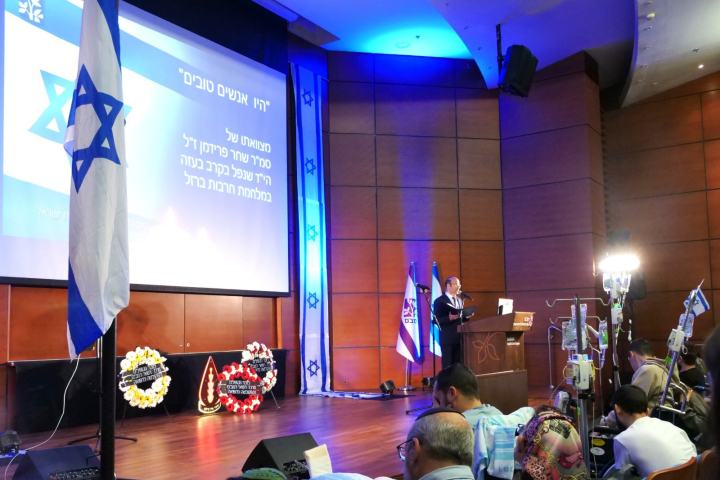 Hospitalized soldiers at Rambam during the Memorial Day ceremony. Photography: Rambam HCC.
In a powerful reflection of both sacrifice and resilience, IV poles lined the front row, delivering continuous pain relief to soldiers who, despite significant injuries, chose to take part in the Memorial Day ceremony. Two soldiers who wished to attend military ceremonies at a nearby cemetery were equipped with specialized portable infusion pumps, allowing uninterrupted pain management without reliance on fixed electrical systems—a capability unique to Rambam.
“Pain is a complex and critically important condition to treat,” says Dr. Ruth Edery, Director of the Acute Pain Service in the Department of Anesthesiology at Rambam. “When wounded soldiers arrive, even if they do not require surgery, our priority is to determine how to help them manage pain in the most effective way possible.”
Dr. Edery explains that Rambam employs a range of advanced interventions tailored to each patient, including targeted nerve blocks for limb injuries, epidural analgesia for more extensive trauma, and customized pharmacological therapies when needed. Each soldier is supported by a dedicated member of the Acute Pain Service who develops an individualized, comprehensive treatment plan.
“The level of pain in these injuries is often severe,” she adds. “Our approach is designed to maximize relief while minimizing the risk of dependence on opioid medications.”
Rambam is currently treating 15 soldiers with varying degrees of injury. Those who participated in today’s ceremony were supported with continuous nerve block systems—portable pumps that deliver local anesthetic directly to affected nerves, maintaining consistent pain control.
Delivering this level of care requires close coordination with Rambam’s Department of Anesthesiology and significant clinical resources, both during wartime and routine operations. “Despite the heavy demands on our operating rooms, our teams remain fully committed to doing everything possible for these soldiers,” says Dr. Edery. “Easing their pain is an essential part of their care.”
