Physicians, nurses, and acupuncturists at Rambam Health Care Campus (Rambam) recently received training in battlefield acupuncture to expand treatment options for patients with war-related injuries who experience pain and stress.
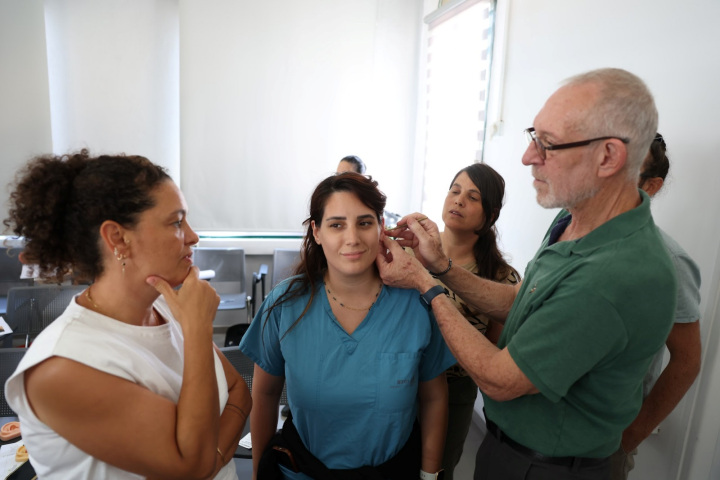 Healthcare professionals learn battlefield acupuncture during a workshop at the Rambam Knowledge Center. Photography: Rambam HCC.
Since October 7, hundreds of war casualties—soldiers and civilians—have arrived at Rambam for medical care. Their care draws on the hospital’s specialized expertise and experience gained throughout Israel’s wars. Alongside conventional medicine, Rambam is integrating another treatment approach to help patients cope with war-related pain and stress.
The U.S. military developed battlefield acupuncture (BFA) to reduce reliance on pain medications such as opioids and complement conventional medical care. Unlike traditional Chinese acupuncture, BFA is a form of auriculotherapy, a treatment approach focused on the ear. Practitioners insert specially designed dart-shaped needle at specific points on the outer ear, where it remains until it falls out on its own.
Recently, the Rambam Knowledge Center held a hands-on workshop led by Tuvia Scott, a leading local and international BFA expert, introduced the technique to clinicians from the hospital's Institute of Pain Medicine and other departments. Participants learned the principles of the technique and practiced treating selected points on the outer ear.
“The aim is to give clinical teams another simple, practical option they can incorporate into multidisciplinary care to respond quickly when patients need relief from pain and stress,” explains Oshrat Eilat, head of Rambam’s acupuncture service, who initiated and organized the workshop.
Eilat says the value of the training extends beyond learning a new treatment technique. “Bringing acupuncturists, physicians, and nurses together is a significant part of this initiative. It's another step toward developing a shared language and an integrative approach in which each clinician contributes their specific expertise for the patient’s benefit.”
Caring for combat-related casualties presents complex challenges, including managing pain, stress, and trauma. No single pain treatment works for everyone. By expanding its pain-management toolkit, Rambam gives its teams more options to help each patient find relief.
