For patients with epilepsy who undergo advanced brain mapping, identifying the precise source of their seizures is essential for determining the next stage of treatment. Performing even a small neurosurgical procedure at a patient's bedside, deep underground, underscores the expertise and adaptability of the medical teams at Rambam Health Care Campus (Rambam) in Haifa, Israel.
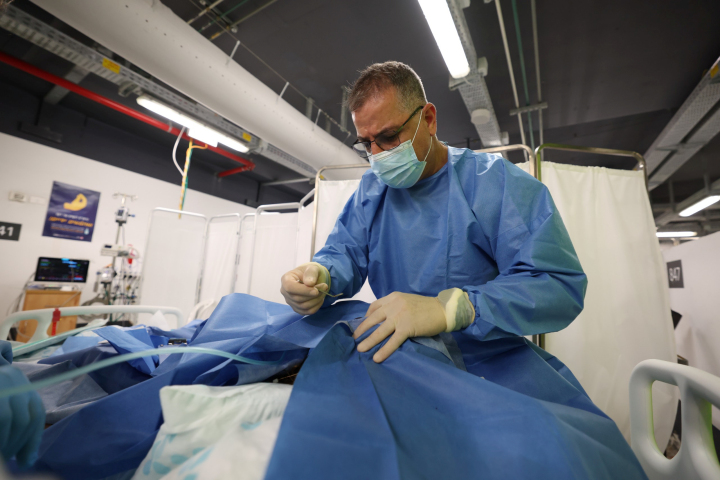 Professor Mony Benifla performs a delicate procedure in Rambam’s underground hospital. Photography: Rambam HCC.
For more than two and a half years, Rambam has repeatedly performed surgical procedures from within its Fortified Underground Emergency Hospital. This unique facility, normally a three-level underground parking garage, can rapidly transform into a fully operational hospital designed to function during emergency scenarios. Earlier this week, following escalating hostilities and missile attacks from Iran, Rambam once again began moving patients underground.
Hospital teams swiftly transferred patients and equipment underground, including one patient in the Department of Neurology. After the patient was moved to level minus three, Rambam physicians removed electrodes from the patient’s brain—one stage of a specialized epilepsy-mapping process.
Physicians perform this procedure dozens of times each year in patients with epilepsy. The procedure is designed to preserve brain function and plays a crucial role in precisely identifying the area responsible for generating seizures and determining the most appropriate course of treatment.
At the patient’s bedside on level minus three, Professor Mony Benifla, director of Rambam’s Pediatric Neurosurgery Unit and an epilepsy surgeon, removed the electrodes from the patient’s brain.
Professor Yitzhak Shiller, director of Rambam's Neurology Institute, and Dr. Moshe Herskovitz, a senior physician in the Department of Neurology, both with specialized expertise in epilepsy, guided this complex multi-phase diagnostic process, which involves implanting ultra-thin electrodes into the brain tissue for deep mapping and then monitoring the patient over several days. The patient remains hospitalized. During this time, physicians monitor and record brain activity and seizures until they collect sufficient data to guide treatment decisions.
In approximately one month, the next stage of the patient’s treatment will begin: treating the epileptogenic zone—the area of the brain identified as generating seizures. Rambam neurosurgeons will then perform a minimally invasive procedure aimed at treating the source of the epilepsy through either targeted ablation or surgical removal.
This intervention can significantly improve seizure control and quality of life for many patients with epilepsy. For this patient, a process that continued deep underground may help open the door to an aboveground future with fewer seizures and a better quality of life.
